
ERW Pipe Production Process
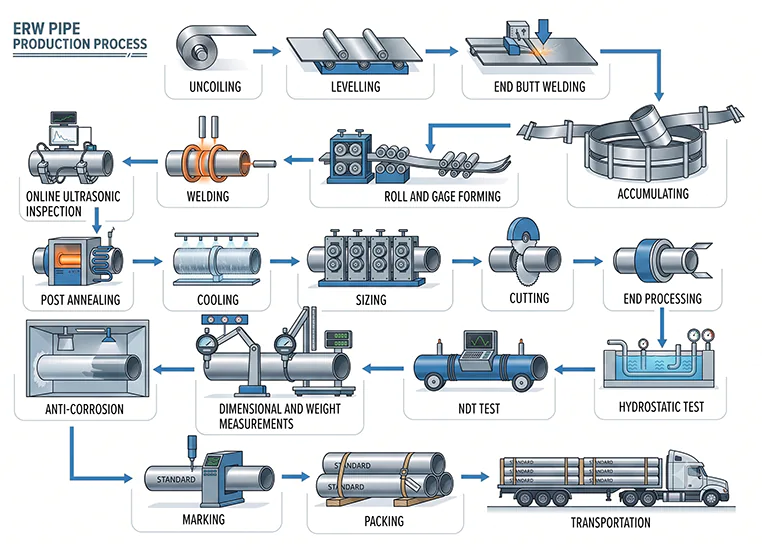
The Electric Resistance Welded (ERW) pipe manufacturing process begins with uncoiling raw steel strips, which are flattened during levelling and joined end-to-end via end butt welding. This continuous strip enters an accumulator to maintain an uninterrupted feed into the roll and gage forming line, where series of rollers gradually shape the flat strip into a tubular profile. High-frequency electric welding then joins the longitudinal seam, followed immediately by an online ultrasonic inspection to monitor early weld integrity.
To refine the physical properties of the seam, the pipe undergoes post-annealing heat treatment and controlled cooling, relieving internal stresses. It is then passed through sizing mills to achieve precise dimensional specifications before being cut into standard pipe lengths and undergoing end processing for beveling or finishing.
The final phase enforces strict quality assurance, subjecting each pipe to hydrostatic testing, advanced non-destructive testing (NDT), and rigorous dimensional and weight measurements. Approved pipes receive a protective anti-corrosion coating, custom identification markings, and are securely packed for onward transportation.
LSAW JOCE Pipe Production Process
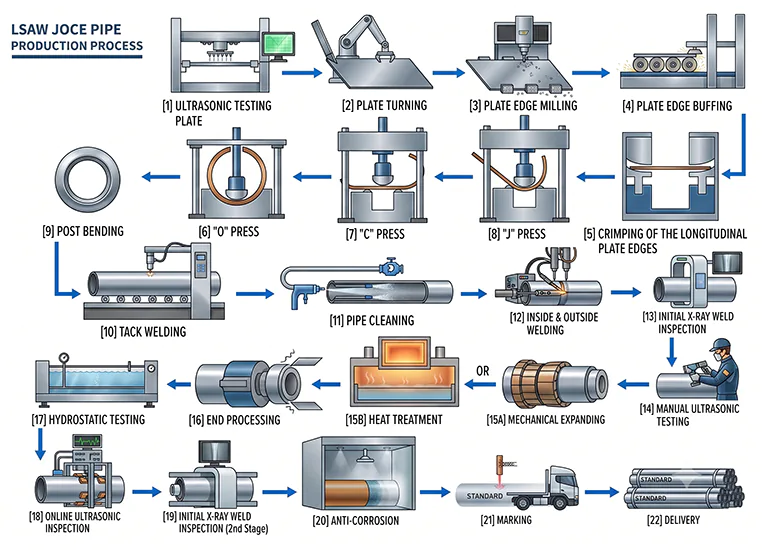
The production of Longitudinal Submerged Arc Welded (LSAW) JOCE pipes follows a meticulous, multi-stage process to ensure the highest quality. It begins with comprehensive ultrasonic testing [1] of the steel base plate, which is then prepared through precise edge milling [3] and buffing [4]. The unique JOCE forming sequence is then executed, involving the crimping [5] of the plate edges, followed by sequential pressing into "J," "C," and finally "O" shapes [8, 7, 6], with a post-bending step [9] to refine the pipe's fit-up. Once formed, the pipe seam is tack welded [10], cleaned [11], and then subjected to complete inside and outside submerged arc welding [12]. Initial quality control is rigorous, involving an initial X-ray inspection [13] and manual ultrasonic testing [14] of the weld seam. The pipe is then precisely sized, either via mechanical expanding [15A] or heat treatment [15B], and its ends are processed [16]. Following this, the pipe must pass hydrostatic testing [17] for pressure resistance, another online ultrasonic inspection [18], and a second-stage X-ray inspection [19]. Final steps include applying an anti-corrosion coating [20], marking the pipe for traceability [21], and preparing it for delivery [22].
Seamless Pipe Production Process
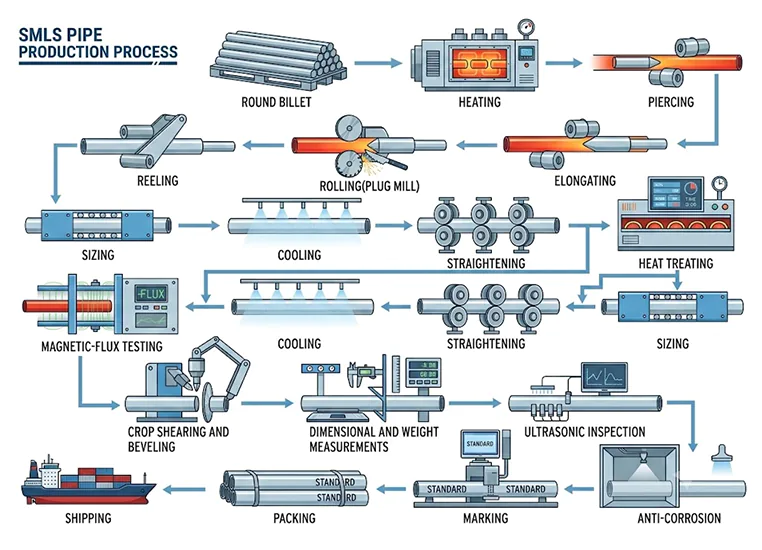
Our seamless (SMLS) pipe manufacturing process transforms raw steel into high-precision, heavy-duty piping through a rigorous, multi-stage hot-forming and quality-controlled sequence:
- Hot Forming & Piercing: Solid round billets are loaded into a furnace for high-temperature heating to achieve optimal plasticity. The heated billet undergoes rotary piercing to form a hollow tube, followed by elongating and plug mill rolling to stretch the pipe and uniform the wall thickness.
- Surface Refining & Sizing: The pipe is processed through a reeling mill to smooth both interior and exterior surfaces before entering initial sizing, controlled cooling, and precision straightening stages.
- Thermal Processing & Calibration: To refine grain structure and ensure required mechanical properties, the pipe undergoes dedicated heat treating, followed by secondary sizing, straightening, and cooling passes to ensure exact dimensional tolerances.
- Quality Assurance & Inspection: Every pipe undergoes non-destructive evaluation, starting with magnetic-flux testing for surface defects, followed by crop shearing and beveling of the pipe ends. Detailed dimensional and weight measurements verify physical standards, while ultrasonic inspection detects any internal flaws.
- Finishing & Logistics: Approved pipes receive a protective anti-corrosion surface coating, detailed stencil marking for traceability, and are bundled during packing for safe global shipping.
SSAW Pipe Production Process
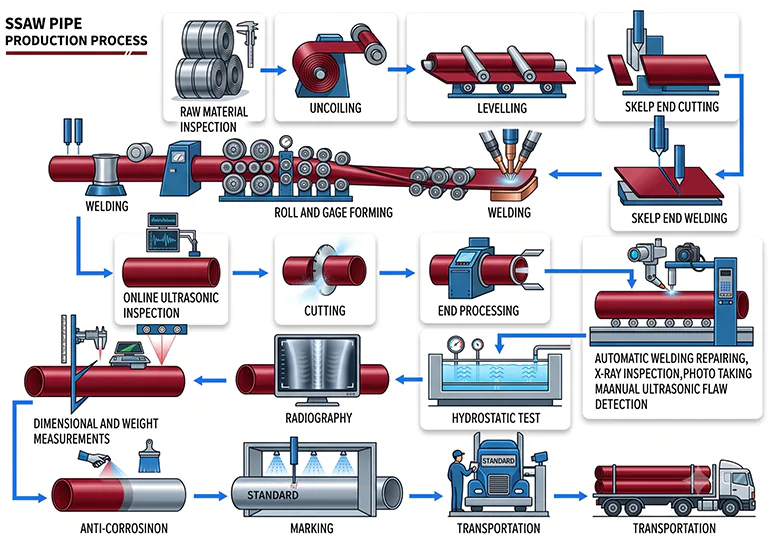
The Spiral Submerged Arc Welded (SSAW) pipe manufacturing process begins with rigorous Raw Material Inspection of hot-rolled steel coils, which are processed through Uncoiling, Levelling, and Skelp End Cutting & Skelp End Welding to form a seamless, continuous steel strip. This strip feeds directly into precision Roll and Gage Forming machinery, where it is spirally wound into a cylindrical profile and continuously joined using internal and external submerged arc Welding. Real-time seam integrity is monitored via Online Ultrasonic Inspection before the pipe is sectioned to specified lengths during Cutting and prepared via End Processing for end-beveling.
To ensure non-destructive quality control, each pipe undergoes multi-stage inspection, including Automatic Welding Repairing, X-Ray Inspection, Photo Taking, Manual Ultrasonic Flaw Detection, and Radiography, followed by high-pressure Hydrostatic Testing to verify pressure capacity and structural tightness. Once verified through precise Dimensional and Weight Measurements, the pipe receives protective Anti-Corrosion surface coating, official specification Marking, and is staged for final Transportation and delivery.
Request A Quote

Please use the enquiry form to request a quote for your industrial pipes and tubes requirements. Our team will get back to you promptly with the best possible solution.
Alternatively, you can reach us directly at: sales@nagardaskanjishah.com and +91-22-68480999